
Most people in DBT therapy juggle multiple tools between sessions. A paper diary card for emotions. A separate crisis plan printed from therapy. A notes app for skills reminders. A contact list for emergency numbers. By the time a real urge hits, the plan is scattered across four different places—and the urge is not going to wait while you assemble them.
The alternative: put everything in one place. Urge tracking, crisis protocol, skill library, and therapist exports, accessible on the device you already carry everywhere.
This guide shows how to build that combined system using DBT Pal and the DBT Crisis Kit, step by step.
Why Urges and Crisis Plans Belong Together
In standard DBT, urge tracking and crisis planning are taught as separate skills but used together in practice. Here is how they connect:
An urge spikes → You need to log it (urge tracking) AND respond to it (crisis plan).
The response involves choosing a skill → You need your skill library accessible in the same moment.
After the urge passes → You need to record what happened (diary card) so your therapist can review it.
When these components live in separate tools, each handoff introduces friction. And friction during a crisis means dropped steps, missed data, and skills that do not get practiced.
A combined system eliminates the handoffs. Open one app. Log the urge. See your skills. Practice one. Record the result. Done.
Get the all-in-one DBT toolkit — download DBT Pal free
What to Look For in an Urge Tracker
If you’re comparing apps, or deciding between an app and paper, these are the things that matter once you’re using it mid-urge. They apply to any tool, this one included.
Speed to log. An urge can peak and fade in under a minute. If capturing it takes more than a few taps, you’ll skip it, and the version you reconstruct that night will be vaguer.
Urge and action recorded separately. DBT treats having an urge and acting on it as two different things. A tracker that folds them into one mood rating hides the 7/10 urge you rode out, which is the part worth seeing.
Skill linkage. Each entry should let you tag the skill you tried and whether it helped. Without that, you can’t tell which skills actually lower which urges.
Privacy by default. Urge logs are some of the most sensitive things you’ll ever write down. Check where entries are stored, whether you need an account, and whether sharing is something you choose each time.
Cost of the basics. Check whether urge logging itself is free or sits behind a subscription. Paper is free and private too, and plenty of people track well on it.
An export your therapist can read. A dated summary you can send before a session saves session time you’d otherwise spend reconstructing the week.
Step 1: Set Up Your Urge Categories
Work with your therapist to identify your target behaviors—the specific urges you are tracking and working to manage. Common categories include:
- Self-harm (cutting, burning, hitting)
- Substance use (alcohol, drugs, misuse of prescription medication)
- Binge eating or restrictive eating
- Impulsive spending
- Isolation or avoidance
- Aggressive outbursts (yelling, throwing things, physical aggression)
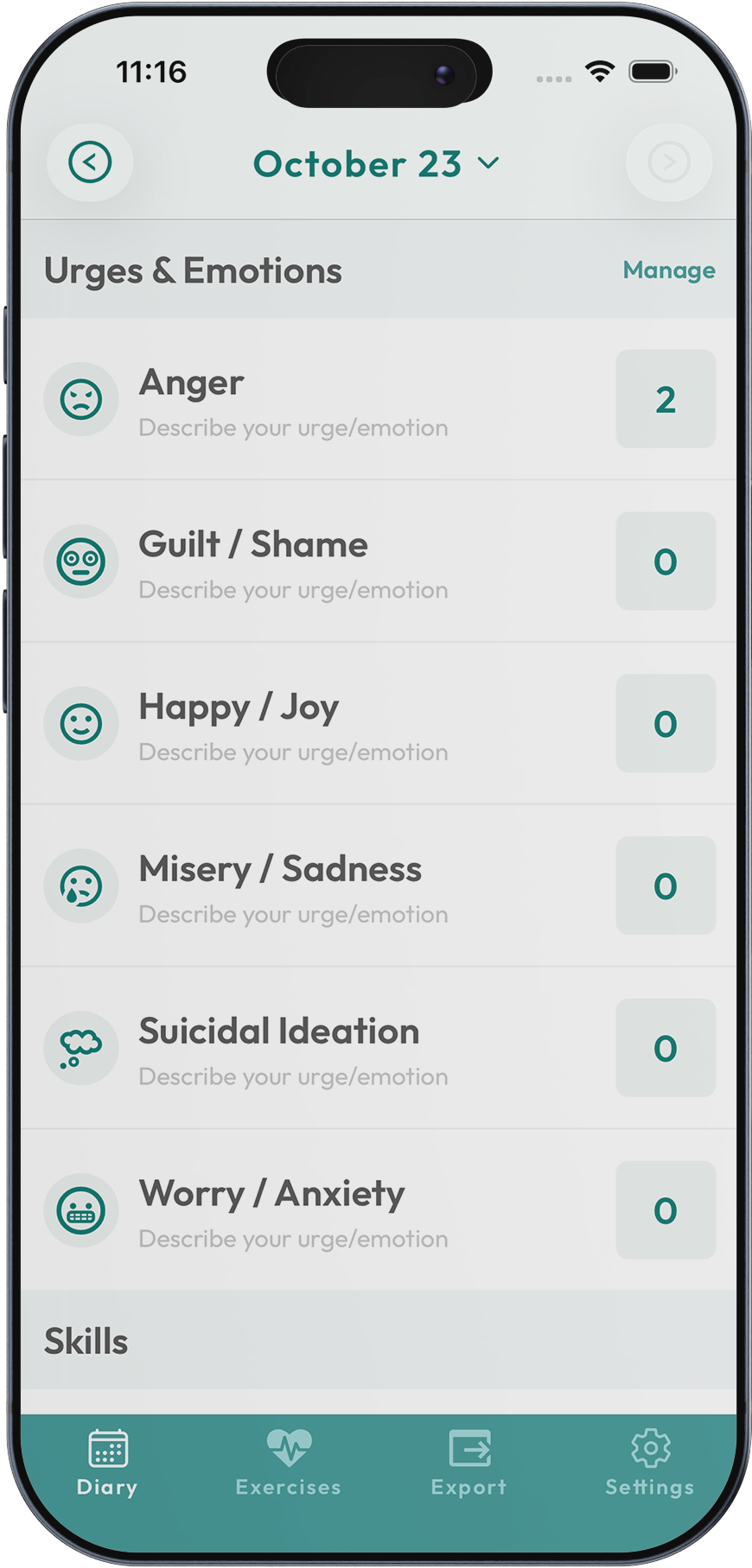
In DBT Pal, these categories appear as one-tap options when you create a diary entry. Select the ones that match your treatment goals and hide the rest. A streamlined interface means faster logging during the moment an urge is active.
For each urge entry, you capture:
| Data Point | Why It Matters |
|---|---|
| Urge type | Which target behavior is pulling? |
| Intensity (0–10) | How strong is the pull? |
| Acted on? | Did you follow through? |
| Skill attempted | What did you try? |
| Skill effectiveness | Did it help? |
This five-point capture takes under 30 seconds and creates therapy-ready data. Over weeks, patterns emerge: which urges are decreasing in frequency, which skills consistently lower intensity, which triggers keep recurring.
Step 2: Build Your Crisis Protocol
A crisis protocol is a pre-planned sequence of steps you follow when distress exceeds your normal coping capacity. Building it during a calm moment means you do not have to think clearly during a crisis—just follow the steps.
The Protocol Structure
Level 1: Safety Check (5 seconds)
Rate your urgency on a 0–10 scale:
- 0–5: Manageable. Use standard diary card + skill practice.
- 6–8: Elevated. Follow the distress tolerance sequence below.
- 9–10: Crisis. Contact emergency services: call 988, text HOME to 741741, or go to your nearest ER.
Level 2: Physiological Reset (2 minutes)
Start with TIPP:
- Temperature — Cold water on face, ice pack on cheeks (activates dive reflex, lowers heart rate)
- Intense exercise — 60 seconds of jumping jacks, sprints, or push-ups
- Paced breathing — Inhale 4 counts, hold 4, exhale 6–8
- Paired muscle relaxation — Tense shoulders for 5 seconds, release while exhaling
Level 3: Skill Application (2–5 minutes)
Based on your current state:
- High arousal → Continue TIPP or add self-soothe
- Emotional pain → Opposite action or radical acceptance
- Interpersonal trigger → Review DEAR MAN before responding
- General overwhelm → 5-4-3-2-1 grounding
Level 4: Record and Debrief (1 minute)
Return to DBT Pal. Complete the diary entry:
- Rate skill effectiveness
- Add notes about what worked and what did not
- Flag anything to discuss with your therapist
Where to Store Your Protocol
Keep it in two places for redundancy:
- DBT Pal skill library — Browse skills by category during the moment. The app serves as your quick-reference guide.
- DBT Crisis Kit — A printable checklist for offline situations (phone dead, no signal, group therapy where phones are not allowed).
Pair DBT Pal with the Crisis Kit — download free
Step 3: Practice the Drill
A crisis protocol only works if the steps are automatic. That means practicing during calm moments:
Week 1: Walk through the full protocol once. Open DBT Pal, create a test entry, browse the skill library, select a skill, practice it for 2 minutes, record the result. Time yourself.
Week 2: Practice the TIPP sequence daily. Cold water on the face in the morning. Paced breathing during your commute. This builds physiological familiarity so the skills activate faster under stress.
Week 3: Simulate a scenario. Think of a recent trigger. Mentally walk through: “If this happened again, I would (1) rate urgency, (2) log the urge, (3) try TIPP, (4) try opposite action if TIPP is not enough, (5) record the result.”
By the time a real crisis hits, the steps feel familiar rather than foreign. The difference between “I need to figure out what to do” and “I know the sequence—just start” can be the difference between acting on an urge and riding it out.
Step 4: Connect to Your Therapist
The urge and crisis data you log becomes some of the most valuable information your therapist receives. Here is how to make that handoff efficient:
Weekly exports. Set a recurring reminder to export your DBT Pal data every Sunday night or Monday morning. Email the export to your therapist before your session. They can review it in advance and focus session time on patterns rather than reconstruction.
Flag high-intensity entries. When you log a crisis-level entry (urgency 8+), add a note: “Want to discuss this in session.” Your therapist will know to prioritize it.
Track skill effectiveness over time. After 4–6 weeks of consistent logging, you and your therapist will have enough data to answer critical questions:
- Which skills consistently lower your urge intensity?
- Which triggers produce the highest-intensity urges?
- Are urge frequency and intensity trending down over time?
- Which skills do you reach for but rarely find helpful?
This data transforms therapy from “tell me about your week” to “I can see that Tuesday and Thursday had the highest urge spikes—both after work interactions. Let’s look at what skill worked on Tuesday and try it for Thursday’s pattern.”
Step 5: The 60-Second Crisis Response
Here is the complete workflow, from urge onset to logged entry, in under 60 seconds:
- Notice the urge (0 seconds) — Pause. Do not act.
- Open DBT Pal (3 seconds) — Keep it on your home screen so it is one tap away.
- Rate urgency (5 seconds) — Is this manageable (0–5), elevated (6–8), or crisis (9–10)?
- Log urge type and intensity (10 seconds) — Tap the category, drag the slider.
- Choose a skill (5 seconds) — Browse the skill library if needed.
- Practice the skill (30 seconds – 5 minutes) — TIPP, grounding, opposite action.
- Record the result (10 seconds) — Effectiveness rating, brief note.
Total for entry alone: ~30 seconds. Total including skill practice: 1–5 minutes. This is the time investment that creates therapy-ready data, reinforces skill use, and builds the evidence base for your own progress.
When the App Is Not Enough
Clear boundaries matter:
If your urgency is 9–10, do not try to self-manage. Call 988 (Suicide & Crisis Lifeline), text HOME to 741741 (Crisis Text Line), or go to your nearest emergency room. Log the entry afterward.
If urges are increasing in frequency or intensity over weeks, bring this data to your therapist urgently. An upward trend in the data is clinically significant and may require treatment adjustment.
If you do not have a therapist, these tools are helpful but insufficient. DBT is designed as a comprehensive treatment program (individual therapy + skills group + coaching). An app supports that program—it does not replace it. Find a DBT-trained therapist through the DBT-LBC therapist directory.
Combining Everything: Your Complete Between-Session System
| Situation | What to Use | Sequence |
|---|---|---|
| Daily tracking | DBT Pal | Evening entry: emotions, intensity, skills |
| Moderate urge (0–5) | DBT Pal | Log urge → browse skills → practice → record |
| Elevated urge (6–8) | DBT Pal + Crisis Kit | Safety check → TIPP → skill practice → record |
| Crisis (9+) | Emergency services | Call 988 / text 741741 / go to ER → log afterward |
| Offline moment | Crisis Kit (printable) | Follow printed checklist → transcribe to app later |
| Therapy session | DBT Pal exports | Share PDF/CSV → review patterns → adjust plan |
This system covers every between-session scenario with clear escalation paths and no gaps.
Build your between-session system — download DBT Pal
FAQ
Can I track urges and have a crisis plan in the same app?
Yes. DBT Pal combines diary card tracking with a skill library that serves as your quick-reference crisis protocol. Add the printable Crisis Kit for offline backup.
What should a crisis plan include?
A safety check (rate urgency), ranked distress tolerance skills, emergency contacts, environmental changes you can make quickly, and a plan for debriefing with your therapist.
How is urge tracking different from mood tracking?
Urge tracking captures the pull toward specific target behaviors, rates intensity, records whether you acted, and links the urge to the skill you used. Mood tracking is general; urge tracking is DBT-specific.
Is my data private?
Entries are stored on your device, with optional backup to your own iCloud. You choose when and how to export.