
DBT Urges Tracker Apps: Compare Privacy, Speed, and Cost (2026)
Urge tracking is one of the simplest ways to see whether your DBT skills are working. When you log an urge, rate its intensity, note whether you acted on it, and record which skill you tried, you create a data point your therapist can use in session. Over weeks, those data points reveal trends—whether urges are decreasing in frequency, which skills lower intensity most effectively, and which triggers keep recurring.
The problem is that most DBT apps treat urge tracking as a secondary feature. Some bury it behind paywalls. Others require account creation and cloud sync before you can log anything. When an urge lasts 30 seconds and the app takes two minutes to navigate, the moment is gone.
Here is how the most common options compare in 2026—and why the speed and privacy of your tracker matter more than its feature list.
What to Look For in an Urges Tracker
Before comparing specific apps, clarify what actually matters for effective urge tracking:
Speed to log. An urge is time-sensitive. If the app requires more than 3–4 taps to capture an entry, you will skip it. The tracker needs to be faster than the urge.
Urge-action separation. DBT distinguishes between having an urge and acting on it. Your tracker should record both independently. A 7/10 urge that was not acted on is meaningful progress—your app should make that visible.
Skill linkage. The entry should let you tag which DBT skill you used in response to the urge. This creates a feedback loop: over time, you see which skills consistently reduce which urges.
Privacy. Urge data is deeply personal. Your tracker should store entries on-device by default, with export as an opt-in action you control.
Therapy-ready exports. Your therapist needs to be able to review the data. PDF or CSV exports in a structured format save session time.
Try the fastest urge logger — download DBT Pal free
Download DBT PalApp Comparison (2026)
| App | Free Urge Logging | Privacy | Speed to Log | Skill Linkage | Export Options |
|---|---|---|---|---|---|
| DBT Pal | Full diary card free | On-device only, no account required | ~30 seconds with sliders | Yes, per entry | PDF, CSV |
| DBT Coach | Limited; most features behind paywall | Cloud sync required | Extra taps to find urge fields | Partial | Limited in free tier |
| DBT Diary Card & Skills Coach | Some tracking free | Account creation required | Cluttered interface | Yes | Basic export |
| Moodnotes / Daylio | Not DBT-specific | Vendor server storage | Designed for mood journaling | No DBT skill taxonomy | Varies |
| Paper diary card | Free | Fully private | Depends on template design | Manual | Physical copy |
How DBT Pal Handles Urges
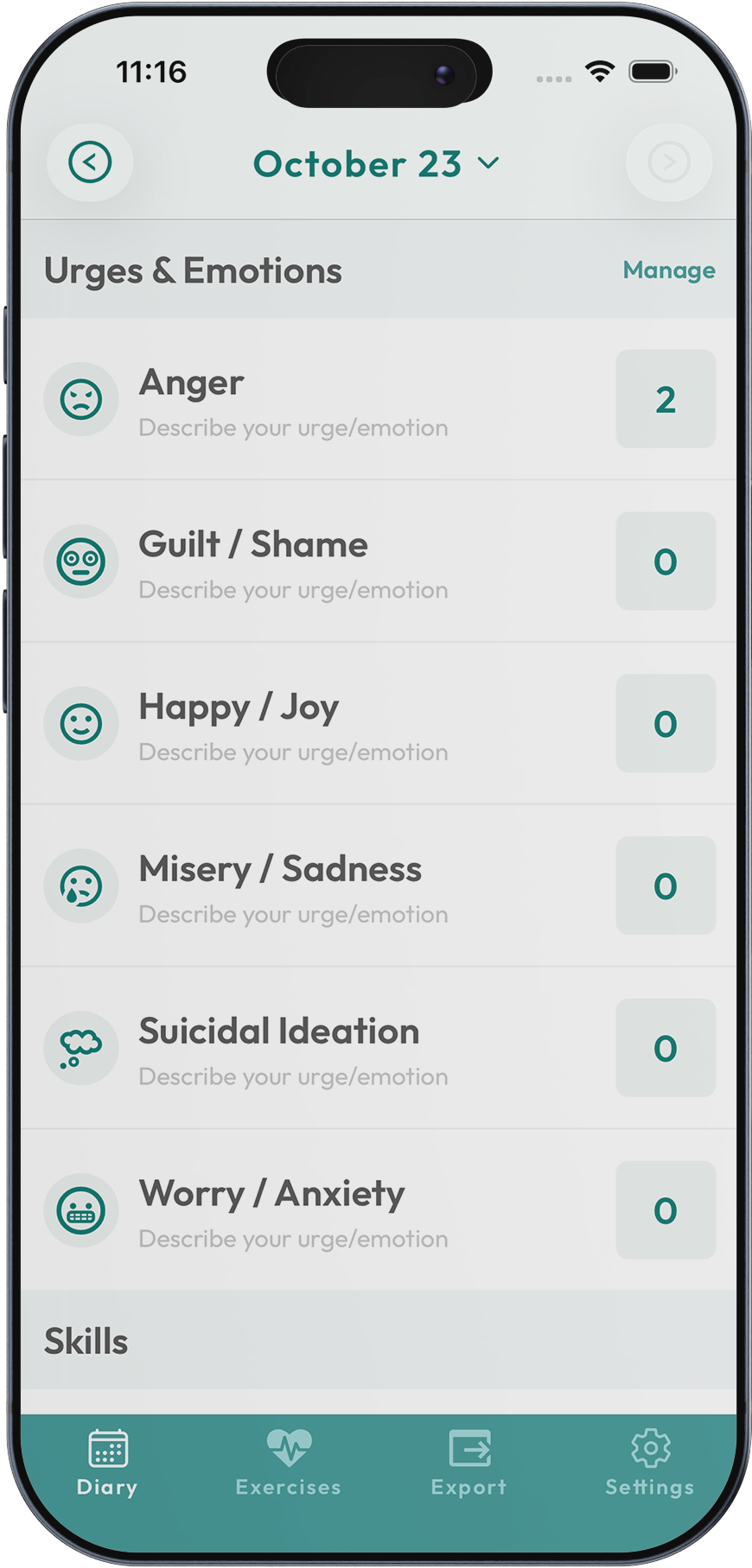
DBT Pal treats urges as a first-class data type—not a checkbox buried inside a mood journal. A single entry captures everything your therapist needs:
- Select the urge type — self-harm, impulsive spending, binge eating, substance use, isolation, or custom categories you define.
- Rate intensity 0–10 — drag the slider. Takes one second.
- Toggle acted-on status — did you act on the urge? Yes or no.
- Tag the skill you tried — even if it only partially worked.
- Rate skill effectiveness — one tap to indicate whether the skill helped.
Because the entry happens on a single screen, it works when an urge is only lasting 30 seconds. You can add notes or leave it blank—the structured fields already capture the data that matters.
Workflows That Make Urge Tracking Stick
Quick-launch logging. Long-press the DBT Pal icon and choose "New Entry" to skip straight to the diary card mid-urge. No navigating through menus.
Crisis Kit pairing. If an urge escalates beyond what simple logging can address, switch to the DBT Crisis Kit grounding checklist. Follow the safety protocol first, then finish the diary entry once you are stable.
Widget on home screen. Keep the DBT Pal widget visible so every phone unlock is a passive reminder. When an urge hits, the widget is one tap away from a new entry.
Therapist export. Use the weekly CSV export so your therapist sees urges, behaviors, and skill effectiveness in a spreadsheet format. No handwriting to decipher, no memory gaps to reconstruct.
Download DBT Pal — private urge tracking on iOS
Download DBT PalWhen an Urge Hits: A 60-Second Protocol
- Pause. Notice the urge without acting on it. Name it internally.
- Open DBT Pal. Tap the quick-launch or widget.
- Log the urge type and intensity. Two taps plus a slider drag.
- Choose a skill. If you are unsure, the app lists options by category—pick the one that fits your current state.
- Practice the skill for 2–5 minutes. Set a timer if it helps.
- Return to the entry. Rate skill effectiveness and add a note about what happened.
This protocol mirrors what a phone coaching call would walk you through, but it keeps you in the driver's seat and creates a permanent record.
What Urge Data Tells Your Therapist
Over weeks and months, logged urges reveal patterns that individual moments cannot:
- Frequency trends — Are urges becoming less common? That is measurable progress.
- Intensity trends — Even if urges still occur, are they less intense? Also progress.
- Trigger correlation — Which events or situations consistently precede strong urges?
- Skill effectiveness — Which skills consistently lower urge intensity? Which ones do you reach for but rarely find helpful?
- Time-of-day patterns — Do urges cluster in the evening, after specific activities, or during certain emotional states?
This data transforms therapy sessions. Instead of spending time reconstructing the week, you and your therapist jump straight to pattern analysis and skill refinement.
When Other Apps Still Help
Urge tracking is one piece of a larger toolkit. You might still use other tools alongside DBT Pal:
- Meditation apps (Headspace, Insight Timer) for urge surfing and mindfulness practice.
- Habit trackers for medication adherence, sleep tracking, and exercise—all factors that affect urge intensity.
- Crisis lines (988 Suicide & Crisis Lifeline) for moments that require immediate human support. No app replaces this.
The key is that your urge data stays in one place. Use other tools for adjacent needs, but keep the core DBT diary card—including urges—consolidated in DBT Pal so your therapist sees the complete picture.
FAQ
Is there a private DBT urges tracker?
Yes. DBT Pal stores all diary entries locally on your device. Nothing is uploaded to a server unless you export it yourself. No account creation required.
Can I track urges for free?
DBT Pal's core diary card features are free, including urge tracking. Premium features are optional. You can also use the printable diary card sheet from the DBT Crisis Kit for paper-based tracking.
How often should I log urges?
Log as soon as an urge appears. A 30-second entry with intensity and skill attempted gives your therapist more useful data than a detailed entry reconstructed at the end of the week.
Start tracking urges today — download DBT Pal
Download DBT Pal