
Adolescence is already an emotional pressure cooker. Add school stress, social media, identity questions, family conflict, and the neurological reality that the prefrontal cortex is still developing, and you have a population that experiences emotions more intensely than adults—with fewer tools to manage them.
That is exactly why DBT works for teens. Dialectical Behavior Therapy for Adolescents (DBT-A) has been adapted specifically for this age group, and the diary card remains one of its most practical tools. But convincing a 15-year-old to fill out a paper worksheet between therapy sessions is a different challenge than the one Marsha Linehan originally designed for.
In 2026, digital diary cards have made this significantly easier. This guide covers how diary cards work for teens, what parents need to know, and how to build a tracking habit that actually sticks.
Why Diary Cards Matter More for Teens
Teens are still building their emotional vocabulary. Most adults can distinguish between “frustrated,” “overwhelmed,” “embarrassed,” and “resentful.” Many teens default to “stressed” or “fine” because they have not yet developed the granularity to name what they are actually feeling.
The diary card teaches that granularity. By choosing specific emotion words and rating intensity on a 0–10 scale, teens develop the ability to:
- Name emotions precisely — “anxious about the test” versus “stressed about everything”
- Separate emotions from urges — “I felt angry AND I had the urge to skip school” (these are different data points)
- Track what actually helps — “Paced breathing worked for anxiety but not for anger”
- See their own progress — Concrete data that shows improvement over weeks, not just a therapist’s reassurance
This self-awareness is the foundation that every other DBT skill builds on. Without it, teens cannot effectively choose which skill to use in a given situation.
Get started with teen-friendly diary tracking
What a Teen Diary Card Looks Like
The structure is the same as an adult diary card, but the language and interface should match how teens communicate:
| Field | Teen-Friendly Version | Example |
|---|---|---|
| Emotion | “What did you feel?” | Anxious, embarrassed, lonely |
| Intensity | “How strong? (0–10)” | 7/10 |
| Urge | “Did you want to do something you’re working on not doing?” | Skip school (6/10), self-harm (4/10) |
| Acted on? | “Did you do it?” | No |
| Skill | “What did you try?” | Paced breathing, texted a friend |
| Trigger | “What happened before?” | Got a bad grade back |
| Notes | “Anything else?” | “Breathing helped a little but I was still upset” |
The key difference for teens: simplicity. An adult might be willing to fill out 15 fields. A teen will abandon the card if it feels like homework. Start with emotions, intensity, and one skill. Add complexity as the habit forms.
Digital vs Paper: Why Teens Need an App
Paper diary cards face specific challenges with adolescents:
Teens lose paper. This is not a character flaw—it is a logistical reality. Backpacks are chaotic. Sheets get crumpled, forgotten, or left in lockers.
Paper feels like homework. Teens already associate worksheets with school obligations. A paper diary card triggers the same resistance.
Privacy concerns are intense at this age. A paper card can be found by a parent, sibling, or classmate. The fear of discovery prevents honest tracking—especially for sensitive urges.
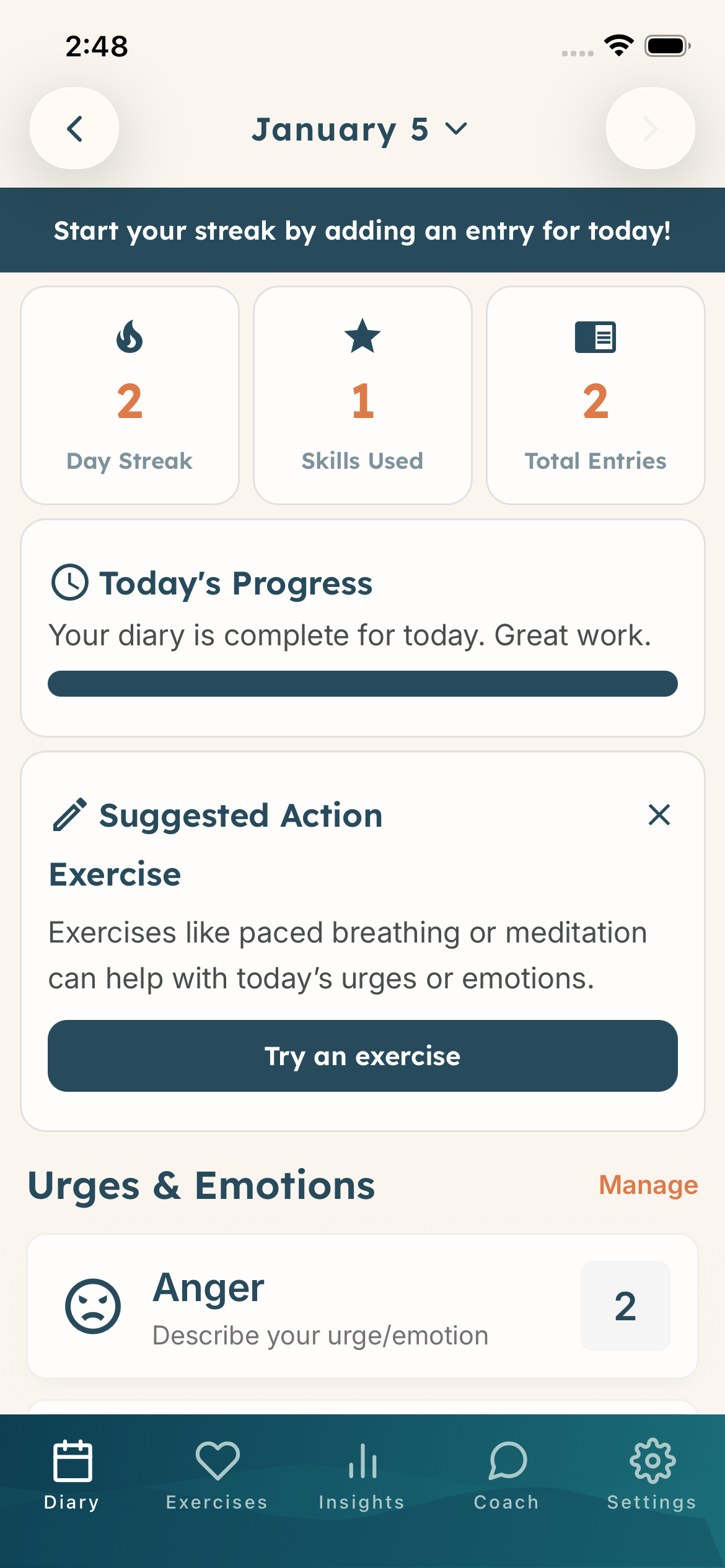
Teens already live on their phones. Meeting them where they are means digital tracking. An app on their phone is always accessible, always private, and does not require carrying an additional item. Our guide to the DBT diary card app covers what to look for.
DBT Pal works well for teens because:
- No account required — No email, no password, no sign-up friction.
- On-device privacy — Entries are stored on the phone, with optional backup to your own iCloud. Nothing is shared unless you export it.
- Fast entry — Under 60 seconds. Tap emotions, drag sliders, select a skill. Done.
- Non-judgmental — No streak penalties, no guilt notifications, no gamification that makes missed days feel like failure.
Getting a Teen Started: Step by Step
Step 1: Have the Therapist Introduce It
The diary card should come from the therapist, not the parent. If a parent introduces tracking, it feels like surveillance. If the therapist introduces it as a tool that helps them help the teen, it is framed as collaborative.
Step 2: Install Together, Then Step Back
Help the teen install DBT Pal on their phone. Do one entry together so they see how it works. Then step back entirely. The diary card is between the teen and their therapist.
Step 3: Start Simple
Hide every module except emotions and intensity. The teen logs what they felt and how strong it was. That is it. Once this becomes a habit (typically 2–3 weeks), add urge tracking. Then skills. Then notes.
Step 4: Set One Reminder
Not three. Not five. One. Choose a time that fits the teen’s existing routine:
- Right after school (transition moment, emotions from the day are fresh)
- Before bed (natural reflection time)
- After dinner (consistent anchor point)
Step 5: Let the Therapist Own the Review
The teen exports their weekly data to the therapist. The therapist reviews it in session and decides what to discuss. Parents get involved through the therapist’s lens, not through direct access to the diary card.
Download DBT Pal — private, fast, and built for daily use
What Parents Need to Know
Do Not Read Your Teen’s Diary Card
This is the most important guideline. If the teen knows a parent might see their entries, they will not track honestly—especially for urges related to self-harm, substance use, or risky behavior. Dishonest tracking is worse than no tracking at all.
The Therapist Will Share What You Need to Know
Your teen’s therapist is trained to identify safety concerns and share them with you appropriately. Trust the clinical process. The diary card data informs therapy, and the therapist involves parents when clinically indicated.
Your Job is to Support the Habit, Not Enforce It
- Remind gently: “Did you do your DBT thing today?” is better than “You need to fill out your diary card.”
- Do not punish for missed entries. Gaps are normal and expected.
- Celebrate effort, not perfection: “I noticed you’ve been doing your DBT stuff regularly—that’s cool” goes a long way.
Model Emotional Awareness
You do not need to fill out a diary card yourself, but naming your own emotions in front of your teen normalizes the practice. “I’m feeling frustrated right now because traffic made me late” shows that identifying emotions is something adults do too, not just a therapy assignment.
Common Challenges with Teen Diary Cards
“It’s boring.” Simplify the interface. If it takes more than 30 seconds, trim it. The data from a 15-second entry (emotion + intensity) is better than no data from an abandoned 5-minute card.
“I forgot.” Set a phone reminder. Pair it with an existing habit (after putting on pajamas, after plugging in the phone to charge). Do not add multiple reminders—that creates nagging, which triggers resistance.
“I don’t want anyone to see it.” Reassure them: DBT Pal stores everything on the device. Nobody can see it unless they export it. Not parents, not siblings, not anyone who borrows the phone.
“Nothing happened today.” Track that too. A calm day with no urges and low-intensity emotions is data. It shows what baseline feels like, which makes it easier to spot deviations.
“I don’t know what I feel.” This is actually the skill the diary card is building. Start with basic categories: mad, sad, scared, happy, disgusted, surprised. As vocabulary grows, the teen will naturally become more specific.
Teens and Specific DBT Skills
Certain DBT skills resonate more with adolescents. When logging skills in the diary card, teens often gravitate toward:
TIPP — The cold water technique (ice on the face) is dramatic enough to feel “real” to teens. Intense exercise also works well because most teens are physically capable of a quick sprint or set of jumping jacks.
Opposite action — Teens understand the concept of doing the opposite of what you feel like doing. “I wanted to isolate but I texted someone instead” is intuitive and the result is often immediate.
DEAR MAN — Interpersonal conflicts dominate teenage life. Having a structured way to ask for what they need (describe, express, assert, reinforce, mindful, appear confident, negotiate) gives teens a framework for conversations with peers, parents, and teachers.
Mindfulness — Short exercises (1–2 minutes) work better than extended meditation. “Notice five things you can see right now” is more accessible than “meditate for 10 minutes.”
For detailed guides on each of these skills:
When to Get Additional Help
Diary cards are part of a treatment plan, not a standalone intervention. If your teen is:
- Experiencing persistent suicidal thoughts or self-harm urges
- Using substances to cope with emotional distress
- Unable to attend school or maintain basic functioning
- Showing signs of eating disorders or severe anxiety
…ensure they are working with a qualified DBT-trained therapist. If your teen is in crisis, contact the 988 Suicide & Crisis Lifeline (call or text 988) or the Crisis Text Line (text HOME to 741741).
Support your teen's DBT practice — download DBT Pal free
FAQ
Are DBT diary cards appropriate for teenagers?
Yes. DBT-A (DBT for Adolescents) includes diary cards as a core component. The structured format builds emotional vocabulary during a critical developmental period.
How do I get my teen to fill out their diary card?
Lower the barrier. Use a phone app instead of paper. Start with just emotions and intensity. Set one reminder. Do not make it feel like homework.
Should parents see their teen’s diary card?
Generally, no. The therapist reviews the data and involves parents as clinically appropriate. Forced access prevents honest tracking.
What age is appropriate?
Most DBT-A programs serve ages 13–18. Younger teens may need simplified versions with fewer options and simpler language.