
DBT Apps for BPD: Finding the Right Tools for Your Practice (2026)
Dialectical Behavior Therapy was developed specifically for Borderline Personality Disorder. The four skill modules—mindfulness, distress tolerance, emotion regulation, and interpersonal effectiveness—target the core challenges of BPD: emotional intensity, relationship instability, identity confusion, and impulsive behaviors.
Learning these skills in therapy is one thing. Using them consistently between sessions is where the real work happens. That gap—between learning a skill on Tuesday and needing it during a crisis on Saturday—is where apps can help.
Not as replacements for treatment. Not as standalone solutions. As support tools that keep skills accessible when your therapist is not in the room and the emotion is already at an 8.
In 2026, the app landscape has matured. Some apps have improved their DBT-specific features. Others have added paywalls that make crisis-moment access frustrating. Here is an updated look at what is available and what actually matters when you are choosing a tool.
What Actually Matters in a DBT App
Before comparing specific apps, clarify the criteria that affect real-world use for people with BPD:
Speed to log an entry. When an urge hits, you have seconds—not minutes—to intervene. If the app requires navigating through menus, creating an account, or dismissing a paywall prompt, you will not use it when you need it most.
Diary card structure. The diary card is central to DBT. Your app should mirror its structure: emotions with intensity, urges with acted-on status, skills practiced, and triggers. A generic mood tracker does not capture the data your therapist needs.
Urge tracking as a core feature. Urge logging is not a premium add-on—it is fundamental to BPD treatment. Apps that gate this behind a paywall are not designed with your needs in mind.
Privacy. For many people with BPD, control over personal data is important. An app that requires cloud accounts and syncs your urge data to external servers creates a barrier to honest tracking.
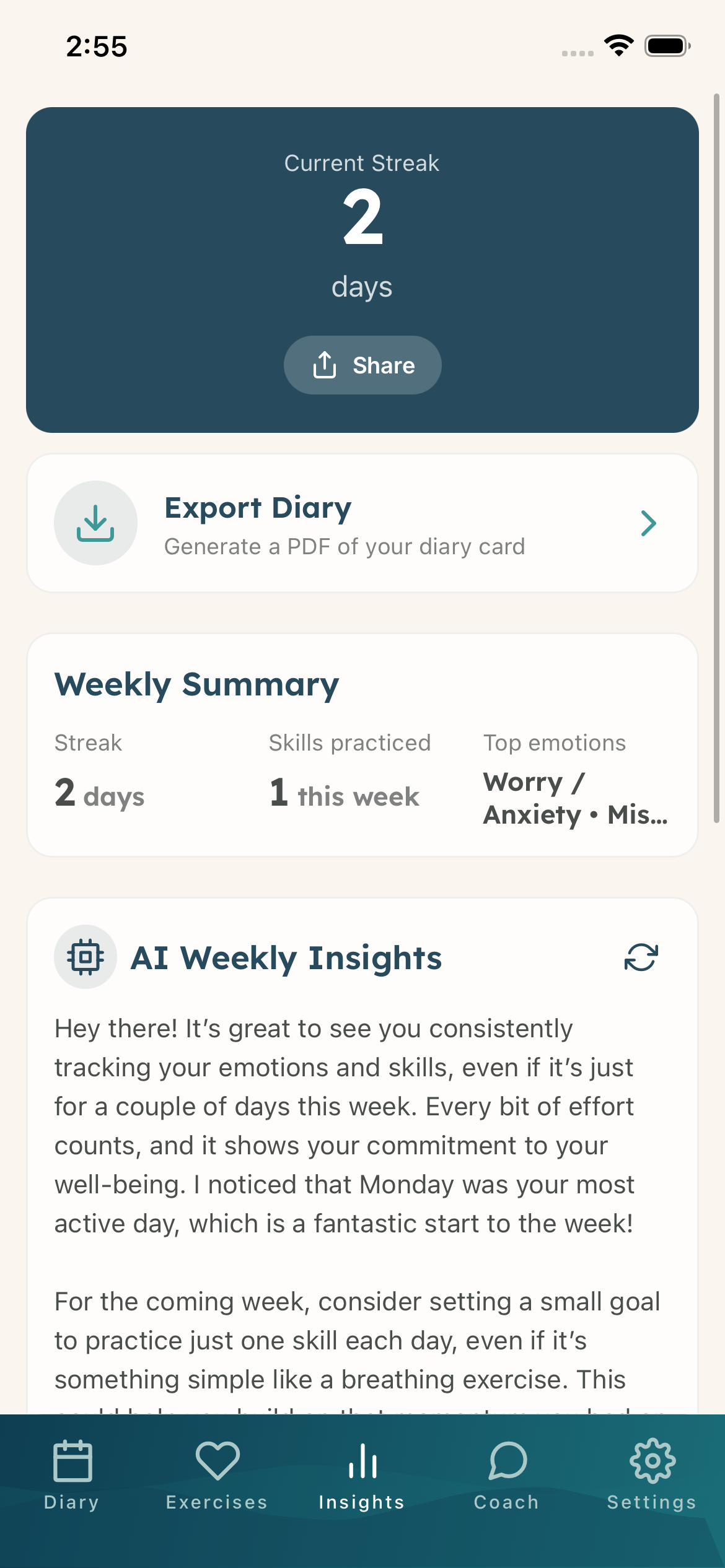
Therapist-ready exports. Your therapist needs to be able to review your entries efficiently. PDF or CSV exports in a structured format save session time.
Non-judgmental design. DBT emphasizes a non-judgmental stance. Apps that shame you for missed days, send passive-aggressive "you haven't logged in 3 days!" notifications, or gamify tracking with punitive mechanics work against the therapeutic approach.
Try the fastest DBT diary card — download DBT Pal free
Download DBT Pal2026 App Comparison
| App | Free Diary Card | Urge Tracking | Privacy | Speed | Export | Design Philosophy |
|---|---|---|---|---|---|---|
| DBT Pal | Full diary card free | Sliders + acted/not acted | On-device, no account required | ~30 sec per entry | PDF, CSV | Fast, private, non-judgmental |
| DBT Coach | Limited without subscription | Behind premium paywall | Cloud sync required | Extra taps to locate fields | Email HTML (paid) | Content-rich but paywall-heavy |
| DBT Diary Card & Skills Coach | Ad-supported | Available but cluttered | Account creation required | Slow due to UI complexity | Basic PDF | Comprehensive but overwhelming |
| Moodnotes | CBT-focused journaling | Not DBT-specific | Vendor server storage | Fast for moods, not DBT skills | CSV | Good journaling, wrong framework |
| Daylio | Generic mood tracking | No DBT structure | Cloud optional | Fast for moods | CSV, PDF | Simplified, not therapy-aligned |
DBT Pal: Built for the Gap Between Sessions
DBT Pal is designed specifically for DBT practice. Here is what that looks like for someone managing BPD:
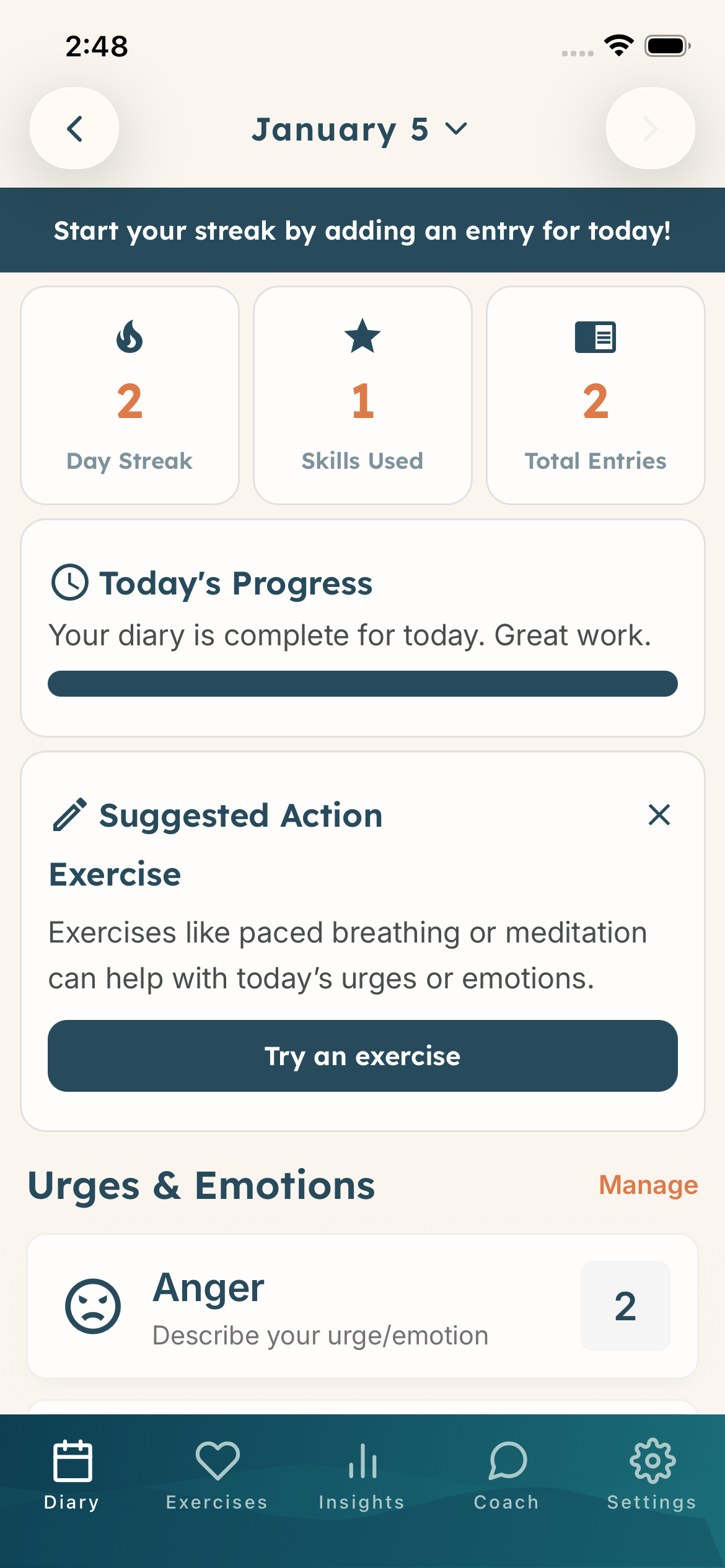
Diary card tracking — Log emotions with intensity sliders, urges with acted-on toggles, and skills practiced—all on one screen. A complete entry takes under 60 seconds.
Skill library — All four DBT modules with organized descriptions. When you are trying to remember which distress tolerance skill fits this particular moment, the library is one tap away.
Urge separation — The app tracks the urge, its intensity, whether you acted on it, and which skill you tried. This separation is critical for BPD treatment—having a 7/10 urge and not acting on it is significant progress that deserves to be recorded.
Pattern insights — Over weeks, the app surfaces trends: which emotions peak, which triggers recur, which skills consistently lower intensity. This data transforms therapy sessions from reconstruction to analysis.
Privacy — All entries stay on your device. No account creation, no cloud sync, no server storage. You export when and where you choose.
Non-judgmental reminders — Optional prompts to log, without guilt trips or streak-breaking penalties.
How This Supports BPD Treatment
For people with BPD, the between-session gap is where skills either solidify or atrophy. DBT Pal supports that critical window:
- Emotional intensity spikes — Quick-launch logging captures the moment before it fades.
- Urge surfing — Log the urge, pick a skill, practice it, then record the result. The structure mirrors phone coaching.
- Therapy preparation — Export your week's data before session. Walk in with data instead of memory.
- Pattern recognition — Recurring triggers become visible. You and your therapist can plan for them proactively.
- Skill reinforcement — Browsing skills during calm moments builds familiarity that pays off during crises.
Download DBT Pal — built for BPD treatment support
Download DBT PalApps That Complement Your DBT Practice
Beyond your primary diary card app, other tools can support specific aspects of treatment:
Mindfulness apps (Headspace, Insight Timer) — Support the mindfulness module with guided meditation and body scans. Not DBT-specific, but useful for building the observation skills that underpin all four modules.
Crisis support — The 988 Suicide & Crisis Lifeline app provides immediate human support. No app replaces a crisis line when you are in danger.
Sleep and habit trackers — PLEASE skills (the physical health component of emotion regulation) benefit from tracking sleep, nutrition, exercise, and medication adherence. Use whatever tracker you already have.
The DBT Crisis Kit — A printable + digital safety plan that complements DBT Pal for offline moments or high-intensity crises where a structured checklist helps more than a diary entry.
The goal is not to have the most apps. It is to have the right tools accessible at the right moments.
What Apps Cannot Do
Be clear about limits:
Apps cannot replace a trained DBT therapist. The clinical judgment, real-time feedback, and therapeutic relationship that a therapist provides are irreplaceable.
Apps cannot substitute for skills group. Group dynamics—validation from peers, seeing others practice, the accountability of showing up—are core to standard DBT.
Apps cannot handle emergencies. If you are in immediate danger, call 988, text HOME to 741741, or go to your nearest emergency room. No app replaces emergency services.
Apps cannot teach nuance. They can remind you that opposite action exists, but your therapist teaches you when it applies, when it does not, and how to adjust it for your specific situations.
Think of apps as one piece of a comprehensive treatment plan—not the plan itself.
When an App Helps Most
DBT apps provide the most value when:
- You are actively in DBT treatment (individual therapy + skills group)
- Paper diary cards keep getting lost, filled out late, or skipped
- You want skills accessible in your pocket during emotional moments
- Consistent tracking has been difficult to maintain despite wanting to do it
- You want structured data to bring to therapy instead of reconstructed memories
If you are not currently in treatment, apps alone are unlikely to provide the support BPD requires. Start with a DBT-trained therapist, then add app support once skills training is underway.
Getting Started
- Download DBT Pal and create your first diary entry.
- Duplicate the DBT Crisis Kit for offline backup.
- Show your therapist the app and exports so they know what data they will receive.
- Set one daily reminder to log—evening works well for most people.
- Review your first week of data before your next session.
Start your DBT practice — download DBT Pal free
Download DBT PalFAQ
What is the best DBT app for BPD in 2026?
DBT Pal offers the fastest diary card workflow with full privacy. Urge tracking and skill logging are free core features, not premium add-ons.
Is there a free DBT diary card app?
DBT Pal's core features are free. Premium extras are optional. The DBT Crisis Kit printable diary card is also free.
How do I choose between DBT apps?
Compare logging speed, urge tracking availability, privacy model, and export formats. Test the app during a calm moment to make sure it works when emotions are high.
Can a DBT app replace therapy for BPD?
No. Apps support practice between sessions. Comprehensive DBT—individual therapy, skills group, and coaching—is the treatment standard.