
10 Effective DBT Distress Tolerance Exercises You Can Try Today
Distress tolerance is one of the four core skill modules in Dialectical Behavior Therapy. Unlike emotion regulation—which focuses on changing how you feel—distress tolerance is about surviving intense emotions without making the situation worse. No fixing, no solving, no numbing. Just getting through it with your relationships, your safety, and your dignity intact.
These skills matter most in the moments when rational thinking goes offline. When anxiety spikes to an 8, when anger makes you want to say something you cannot take back, when an urge to self-harm feels overwhelming—distress tolerance gives you a concrete action to take instead of reacting on autopilot.
In 2026, the evidence base for these techniques continues to grow. Distress tolerance skills have shown effectiveness not just for BPD (the original DBT population) but for anxiety disorders, substance use, eating disorders, and chronic pain management. The common thread: when you cannot change the situation, you can still change your response.
Here are ten exercises you can try today, ranked roughly by how quickly they shift your physiological state.
1. TIPP Skills
TIPP is the fastest distress tolerance technique because it works directly on your body's arousal system. Each letter targets a different physiological pathway:
Temperature — Splash cold water on your face or hold an ice pack to your cheeks and forehead. This activates the mammalian dive reflex, which slows your heart rate and redirects blood flow. The effect is measurable within 30 seconds.
Intense exercise — A quick burst of physical activity (jumping jacks, sprinting in place, push-ups) burns off the adrenaline that fuels panic and anger. Even 60 seconds of intense movement shifts your body chemistry.
Paced breathing — Slow your exhale to be longer than your inhale. Inhale for 4 counts, hold for 4, exhale for 6–8. This activates the parasympathetic nervous system and counteracts the fight-or-flight response.
Paired muscle relaxation — Tense a muscle group (fists, shoulders, calves) for 5 seconds while inhaling, then release completely while exhaling slowly. Work through 3–4 muscle groups.
TIPP is your first-line skill for high-arousal states—panic attacks, rage, overwhelming urges.
Track your TIPP practice in DBT Pal
Download DBT Pal2. Self-Soothe with the Five Senses
When distress is painful but not at crisis level, engaging your senses creates a counter-experience that grounds you in the present:
- Sight — Look at a photo that brings calm, watch a nature video, or step outside to look at the sky.
- Sound — Play a specific song you have associated with calm (not just any music—choose it in advance). Nature sounds and binaural beats also work.
- Touch — Hold a smooth stone, wrap yourself in a textured blanket, or run your hands under warm water.
- Taste — Sip herbal tea, eat a piece of dark chocolate slowly, or bite into something sour (the intensity can interrupt emotional spiraling).
- Smell — Use a specific essential oil, scented lotion, or familiar smell you have linked to safety.
The key is to engage each sense deliberately, not passively. Notice the sensation. Describe it to yourself. This is mindfulness in action.
3. 5-4-3-2-1 Grounding
This exercise pulls your attention out of spiraling thoughts and back into your immediate environment:
- Name 5 things you can see
- Name 4 things you can touch (and touch them)
- Name 3 things you can hear
- Name 2 things you can smell
- Name 1 thing you can taste
The counting structure gives your brain a task. When your prefrontal cortex is busy counting and categorizing sensory input, it has less bandwidth for catastrophizing.
4. Radical Acceptance
Radical acceptance is not approval, agreement, or giving up. It is the decision to stop fighting reality. When you catch yourself thinking "this shouldn't be happening" or "this isn't fair," you are spending energy resisting what already exists.
Practice by:
- Noticing the resistance ("I am fighting against what is true right now")
- Turning your mind toward acceptance, even if you have to do it repeatedly
- Saying internally: "This is what is happening. I can respond to it, but I cannot un-happen it."
Radical acceptance reduces the suffering that comes from fighting reality. The pain may remain, but the layer of anguish about the pain lifts.
For more depth on this skill, see our guide to radical acceptance with real-life examples.
5. Wise Mind
Your emotional mind reacts. Your rational mind analyzes. Wise mind integrates both. When you are making a decision while distressed, check whether you are operating from emotion mind, reasonable mind, or the overlap:
- What do I feel? (emotion mind)
- What do I know? (reasonable mind)
- What is the response that honors both? (wise mind)
A simple practice: place your hands on your stomach, breathe slowly, and ask "What would wise mind do here?" Often the answer is quieter than emotion mind's urgency.
For a deep dive, read our guide to wise mind in DBT.
Build your distress tolerance toolkit with DBT Pal
Download DBT Pal6. STOP Skill
STOP prevents impulsive action during high-emotion moments:
- Stop — Freeze. Do not act on the urge.
- Take a step back — Physically step away from the situation if possible. Take a breath.
- Observe — What is happening inside you (emotions, urges, thoughts) and outside you (the situation, other people's behavior)?
- Proceed mindfully — Choose your next action based on wise mind, not on the urgency of the emotion.
STOP buys you time. Most impulsive decisions happen in the first 5–10 seconds of an emotional spike. If you can pause for even 30 seconds, the intensity begins to drop.
7. Distraction with ACCEPTS
Sometimes you need to redirect your attention until the emotional wave passes. ACCEPTS provides seven categories of healthy distraction:
- Activities — Do something that requires focus (puzzle, cleaning, cooking).
- Contributing — Help someone else. Shifting focus to others interrupts self-focused rumination.
- Comparisons — Compare your current situation to times you have coped successfully.
- Emotions — Generate a different emotion (watch a comedy, listen to uplifting music).
- Pushing away — Mentally set the problem aside temporarily. Picture putting it in a box and placing it on a shelf.
- Thoughts — Occupy your mind with neutral tasks (count backwards from 100 by 7s, list state capitals).
- Sensations — Use strong sensory input (ice cube in hand, snapping a rubber band) to interrupt emotional escalation.
Distraction is not avoidance. The difference: avoidance is permanent refusal to deal with the issue. Distraction is a temporary strategy while your arousal drops to a level where you can think clearly.
8. Pros and Cons
When you are facing an urge and unsure whether to act on it, writing a pros/cons grid can engage your rational mind:
| Act on the urge | Resist the urge | |
|---|---|---|
| Short-term | Relief (pro) / Guilt, consequences (con) | Discomfort (con) / Self-respect (pro) |
| Long-term | Setback, damaged trust (con) | Progress, maintained relationships (pro) |
The act of writing forces deliberate thought. Keep a pre-filled version on your phone or in your crisis kit so you do not have to create one during a crisis.
9. Half-Smile and Willing Hands
Body posture affects emotional state. Two subtle physical adjustments can shift your internal experience:
Half-smile — Relax your face completely, then let the corners of your mouth turn up slightly. Not a full smile—just enough to signal relaxation to your nervous system.
Willing hands — Open your hands, palms up, on your knees or at your sides. Unclenching signals to your body that you are not in fight mode.
Try both together for 60 seconds while breathing slowly. The effect is subtle but measurable, especially when combined with paced breathing.
10. Crisis Survival Plan
Prevention works better than reaction. Build your plan before you need it:
- A ranked list of skills to try (TIPP first, then self-soothe, then distraction).
- Contact numbers for support (therapist, crisis line, trusted friend).
- A pre-written pros/cons card for your most common urge.
- Environmental changes you can make quickly (leave the room, go outside, take a shower).
Store your plan in DBT Pal and print a copy from the DBT Crisis Kit. Having the plan accessible matters more than having it memorized.
How DBT Pal Helps You Practice
Distress tolerance skills work best when they are practiced regularly—not just deployed during crises. DBT Pal supports that practice by:
- Skill library with descriptions — Browse distress tolerance techniques with brief explanations so you can review them before you need them.
- Diary card tracking — Log which skills you used, rate their effectiveness, and track urge intensity over time.
- Pattern insights — See which distress tolerance skills consistently lower your intensity and which triggers keep recurring.
- Reminders — Set daily practice prompts so skill review becomes a habit, not an emergency measure.
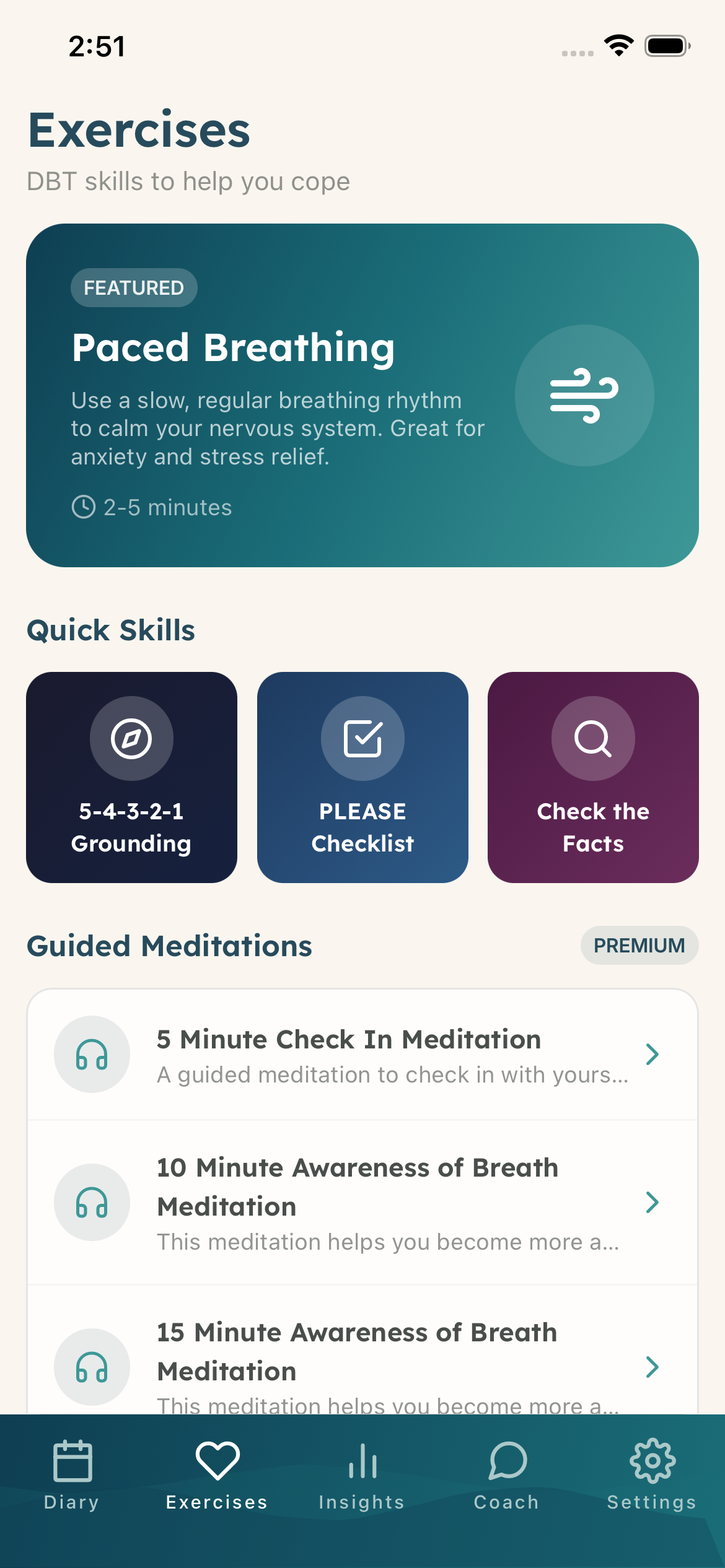
Download DBT Pal — free distress tolerance toolkit
Download DBT PalFAQ
What are distress tolerance skills in DBT?
Distress tolerance skills help you endure painful emotions or crisis situations without making them worse. They focus on acceptance and effective coping rather than immediate change.
Which DBT distress tolerance skill works fastest?
TIPP works fastest because it targets physiological arousal directly. The cold water technique can lower heart rate within 30 seconds.
How often should I practice distress tolerance exercises?
Practice during calm moments so the skills become automatic. Even 5 minutes of daily paced breathing builds the muscle memory that makes crisis use effective.
Can I use distress tolerance skills without a therapist?
You can learn and practice these skills independently, but they work best within a comprehensive DBT program. A therapist helps you match skills to situations and refines your technique.