
DBT Diary Card: How to Use It and Why Tracking Helps
The diary card is one of the most important tools in Dialectical Behavior Therapy—and one of the most underused. Nearly every DBT client understands its value. Far fewer maintain it consistently between sessions.
This is not a motivation problem. It is a design problem. Paper diary cards were created for a clinical setting where therapists hand you a sheet and you fill it out together. The between-session reality—where emotions spike without warning, pens are missing, and the card is at home while you are at work—was never part of the original design.
In 2026, digital tools have caught up to this gap. But understanding what a diary card tracks and why each piece matters will make any format—paper or digital—more effective.
What a DBT Diary Card Actually Tracks
A diary card is not a journal. It is structured data collection. Each section serves a specific purpose in treatment:
Emotions and Intensity
Name what you felt using specific language. "Anxious at 7/10" gives your therapist useful data. "Felt bad" does not.
The intensity scale (0–10) matters because it lets you and your therapist track whether emotions are becoming more manageable over time. A client who reported anxiety at 8/10 three months ago and now reports 5/10 for similar triggers has concrete evidence of progress.
Urges and Target Behaviors
DBT distinguishes between having an urge and acting on it. Your diary card tracks both:
- Urge type: Self-harm, substance use, binge eating, isolation, impulsive spending—whatever target behaviors you and your therapist have identified.
- Urge intensity: How strong was the pull? (0–10)
- Acted on?: Did you follow through on the urge?
This separation is therapeutic in itself. Recording a 7/10 urge that you did not act on makes your coping visible. Over weeks, you can see urge frequency and intensity change—or identify situations that consistently trigger the strongest pulls.
Skills Practiced
Which DBT skills did you use? From which module?
- Mindfulness (observe, describe, participate, wise mind)
- Distress tolerance (TIPP, self-soothe, radical acceptance, STOP)
- Emotion regulation (check the facts, opposite action, PLEASE)
- Interpersonal effectiveness (DEAR MAN, GIVE, FAST)
Even partial or unsuccessful skill use is worth recording. Your therapist wants to see what you tried, not just what worked perfectly.
Triggers and Events
What happened before the emotion spiked? A conversation, a memory, a physical sensation, a news article, an anniversary, a change in plans. Identifying triggers helps you and your therapist anticipate future challenges and cope ahead.
Notes and Reflections
Free-text space for anything that does not fit the structured fields. "Next time I would try opposite action instead of isolation" is exactly the kind of insight that makes your next session productive.
Start tracking with DBT Pal — structured diary cards on iOS
Download DBT PalHow to Fill Out Your Diary Card: Step by Step
Step 1: Choose Your Format
| Format | Best For | Limitations |
|---|---|---|
| Paper (therapist-provided) | Group therapy, handwriting-based reflection | Easy to lose, no automatic analysis, hard to review trends |
| Printable (DBT Crisis Kit) | Offline backup, therapy groups, bag/wallet copy | Same limitations as paper, but always available as a backup |
| Digital (DBT Pal) | Daily tracking, in-the-moment logging, therapy exports | Requires phone, screen time during emotional moments |
Many people use both: digital for daily tracking, paper as a backup for group therapy or offline moments.
Step 2: Log in the Moment (When Possible)
The most accurate entries happen close to the event. You do not need to complete the entire card—just capture the emotion and intensity. Fill in skills and notes when you have a quiet moment.
A 15-second partial entry logged in the moment beats a 5-minute detailed entry reconstructed three days later.
Step 3: Rate with Specificity
Use the full 0–10 scale. Avoid defaulting to 5 or 7 for everything. If you are unsure, bracket it: "somewhere between 6 and 8" is more useful than a reflexive 7.
Rate urges separately from emotions. You can feel anxious at 4/10 with an urge to avoid at 8/10—these are different data points.
Step 4: Name Skills Even When They Do Not Work
If you tried paced breathing and it did not help, log it anyway. Knowing which skills are ineffective for which situations is just as valuable as knowing which ones work.
Step 5: Review Weekly
Before your therapy session, look at the week's entries together. Notice:
- Which emotion showed up most?
- What was the highest-intensity moment?
- Which skills did you use most? Were they effective?
- Are there triggers that keep repeating?
Bring this summary to session. Walking in with data changes the conversation.
Common Diary Card Mistakes
Waiting until the end of the week. You end up guessing at intensity levels, conflating multiple events, and missing skills you actually used. Log daily, or at minimum after each significant emotional event.
Using vague emotion labels. "Stressed" is not specific enough. Was it anxious? Overwhelmed? Frustrated? Resentful? Each has a different skill response.
Only tracking bad days. Positive entries reveal what is working. If you are calm on Wednesday after a good night of sleep and a morning walk, that is PLEASE skill data.
Skipping entries after setbacks. Setbacks are the most valuable data points. They show your therapist what happened, what skill you tried (or did not try), and where the intervention can improve.
Over-tracking. If the card feels overwhelming, reduce the fields. Track just emotions, intensity, and one skill. You can add complexity as the habit solidifies.
Make diary cards sustainable — download DBT Pal free
Download DBT PalExample: A Week of Diary Card Entries
| Day | Emotion (0–10) | Urge (0–10) | Acted? | Skill | Trigger | Notes |
|---|---|---|---|---|---|---|
| Mon | Anxious (7) | Avoid meeting (6) | No | Paced breathing, STOP | Work presentation | Attended despite urge |
| Tue | Frustrated (8) | Snap at partner (7) | No | DEAR MAN | Plans cancelled | Expressed disappointment calmly |
| Wed | Content (4) | None | — | Mindful observation | Morning routine | Noticed and logged positive moment |
| Thu | Sad (6) | Isolate (5) | No | Opposite action | Rejection email | Texted a friend instead |
| Fri | Angry (9) | Yell (8) | No | Check the facts | Family comment | Realized interpretation was distorted |
| Sat | Calm (3) | None | — | PLEASE | Good sleep + exercise | Baseline emotional day |
| Sun | Anxious (5) | Skip group (4) | No | Cope ahead | Monday work anticipation | Reviewed Monday plan in advance |
This week shows diverse skill use, honest urge tracking, and both positive and negative entries. A therapist can scan this in under a minute and focus session time on patterns.
How DBT Pal Makes This Sustainable
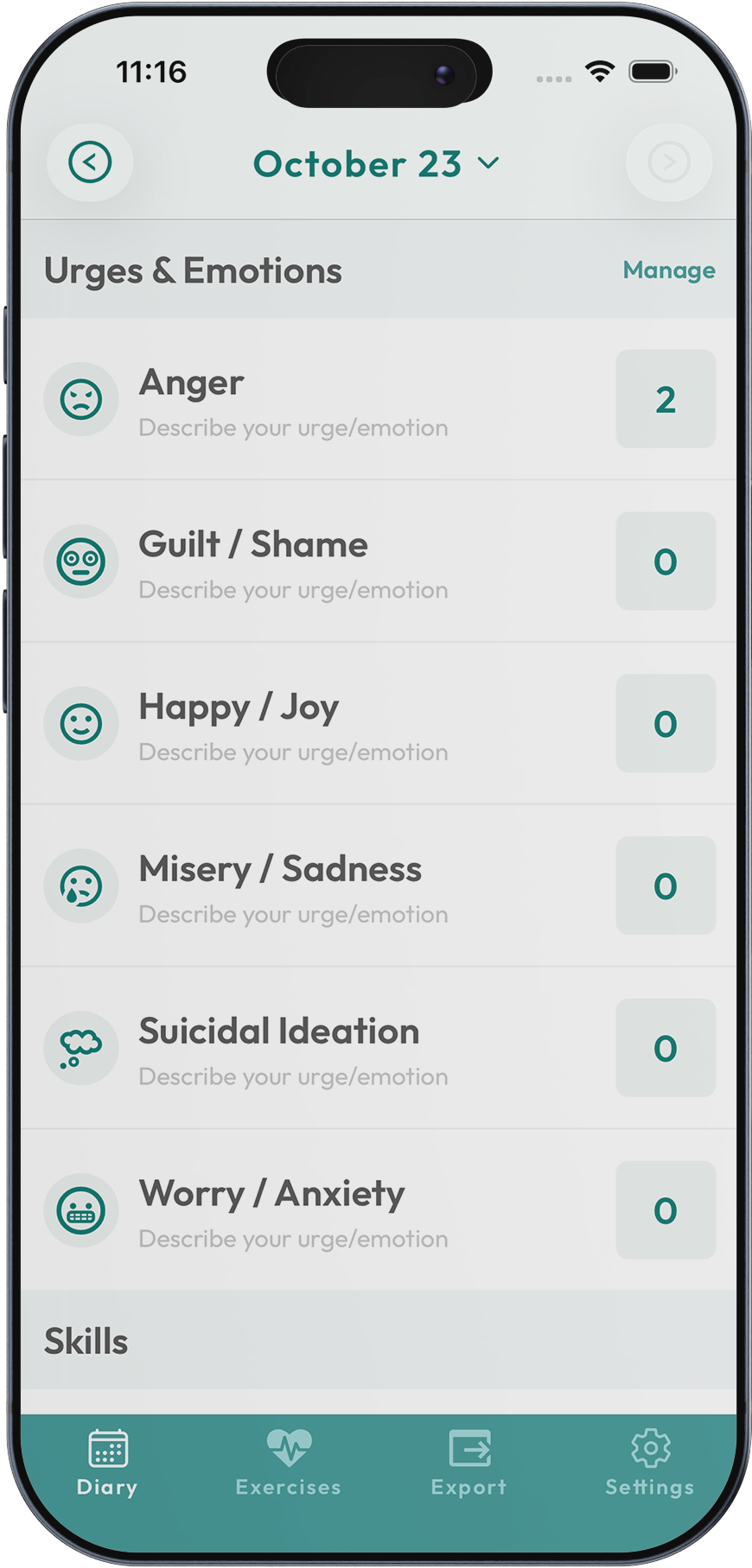
DBT Pal structures the diary card workflow so that daily tracking is fast enough to actually sustain:
- One-screen entries — Emotions, urges, skills, and notes on a single scrollable page. No navigating between tabs.
- Intensity sliders — Drag to rate. Faster than writing numbers.
- Skill suggestions — Browse by module when you cannot remember which skill name applies.
- Pattern insights — The app surfaces trends across weeks so you do not have to calculate them manually.
- Therapy exports — PDF and CSV formats that your therapist can review in advance.
- On-device privacy — All entries stay local unless you export them. No accounts, no cloud sync.
Building the Habit
The most effective diary card strategy is the one you actually use. Here is what works for most people:
- Set one daily reminder. Evening works well—review the day's emotions before bed.
- Pair with an existing habit. Log after brushing teeth, after medication, or after your evening meal.
- Lower the bar. On hard days, just emotion + intensity is enough. You can add details tomorrow.
- Do not chase perfection. A gap is normal. One entry after a gap is more valuable than guilt about the gap.
- Show your therapist. Once your therapist is reviewing your exports, the external accountability helps sustain the habit.
Download DBT Pal — your diary card, simplified
Download DBT PalFAQ
What is a DBT diary card?
A structured daily tracking tool that records emotions, urges, target behaviors, skills practiced, and triggers. It helps you and your therapist identify patterns and measure progress.
How do I fill one out?
Daily: record emotions with intensity, urges and whether you acted, skills you practiced, triggers, and brief notes. Use specific language and rate intensity on a 0–10 scale.
Why do I keep forgetting?
Most people try to fill out the entire card at week's end. Switch to quick in-the-moment entries, set a daily reminder, and pair the habit with something you already do.
Can I use an app instead of paper?
Yes. Digital diary cards are often more consistent and easier to review. DBT Pal mirrors the paper format with faster entry and automatic patterns.