
Mastering DBT Skills for Emotion Regulation: A Practical Guide for Everyday Life
Emotion regulation is the DBT module that changes how you feel—not by suppressing emotions, but by understanding them well enough to influence their intensity and duration. While distress tolerance helps you survive a crisis, emotion regulation prevents the next one.
In 2026, these skills remain among the most researched and validated techniques in behavioral therapy. The evidence continues to grow: people who practice emotion regulation consistently report fewer emotional crises, better relationship quality, and increased ability to pursue long-term goals despite short-term emotional discomfort.
The catch is that emotion regulation skills require practice when you are calm to work when you are not. You cannot learn to surf during a hurricane. This guide breaks down each core skill with practical steps you can start using today.
What Emotion Regulation Actually Means
Emotion regulation in DBT is not about controlling your feelings or becoming emotionless. It is about:
- Understanding your emotions (what triggered them, what they are telling you)
- Reducing vulnerability to negative emotions before they start
- Changing emotional responses when they are not serving you
- Accepting emotions that are appropriate to the situation
A regulated emotional life still includes anger, sadness, fear, and grief. The difference is that these emotions inform your decisions rather than hijack them.
Skill 1: Identify and Label Your Emotions
You cannot regulate what you cannot name. The first step in any emotion regulation practice is accurate labeling.
Most people default to vague categories: "I feel bad," "I'm stressed," "I'm upset." These labels are too broad to be actionable. "Bad" could mean anxious, lonely, ashamed, frustrated, or grieving—and each of those requires a different response.
Practice this today:
- When you notice a strong feeling, pause.
- Ask: "What exactly am I feeling?" Use specific words—anxious, resentful, embarrassed, overwhelmed.
- Rate the intensity from 0–10.
- Ask: "What triggered this?" Identify the event, thought, or situation.
This sounds simple, but emotional granularity—the ability to make fine-grained distinctions between emotions—is a skill that improves with practice. Evidence suggests that people with higher emotional granularity regulate their emotions more effectively.
Log your labels in your diary card. Over weeks, patterns emerge: which emotions show up most often, what triggers them, and how intense they tend to be.
Start tracking emotions with DBT Pal
Download DBT PalSkill 2: Check the Facts
Emotions are responses to your interpretation of events, not the events themselves. Check the Facts examines whether your emotional response matches the actual situation.
The process:
- Name the emotion. "I'm feeling angry."
- Identify the triggering event. "My friend didn't text me back."
- Check your interpretation. "I'm assuming she's ignoring me on purpose."
- Look for alternative explanations. "She might be busy, her phone might be dead, she might not have seen the message."
- Ask: Does my emotion fit the facts? If the intensity (8/10 anger) does not match the situation (a missed text with multiple innocent explanations), the emotion is driven by interpretation, not reality.
Check the Facts does not invalidate your feelings—it tests whether the full intensity is warranted. Sometimes the answer is yes: your anger at 8/10 is appropriate because someone genuinely violated a boundary. Other times, the interpretation was distorted and the intensity drops once you see that.
Real example:
| Step | Application |
|---|---|
| Emotion | Anxious, 7/10 |
| Event | Boss asked to "chat later today" |
| Interpretation | "I'm going to get fired" |
| Alternative explanations | Could be a routine check-in, a project question, positive feedback |
| Does emotion fit facts? | Some anxiety is reasonable (uncertainty), but 7/10 based on one ambiguous message is escalated by catastrophizing |
Skill 3: Opposite Action
When an emotion is not justified by the facts—or when it is justified but acting on it would make things worse—opposite action is the intervention.
The principle: every emotion comes with an action urge. Fear urges you to avoid. Anger urges you to attack. Sadness urges you to withdraw. Shame urges you to hide.
Opposite action means deliberately doing the thing the emotion tells you not to do:
- Fear (unjustified) → Approach what you are avoiding
- Anger (unjustified or destructive) → Be kind or gently avoid, lower your voice, unclench your body
- Sadness (prolonged, not acute grief) → Get active, reach out to people, engage in activities
- Shame (unjustified) → Share with someone you trust, stand tall, make eye contact
- Guilt (justified) → Make amends, then let it go
Opposite action works because emotions and behaviors reinforce each other. Breaking the behavioral pattern interrupts the emotional cycle.
For detailed examples, see our guide to opposite action in DBT.
Skill 4: PLEASE Skills
PLEASE targets the physical vulnerability factors that make you more likely to experience intense negative emotions. When your body is depleted, your emotional system has fewer resources to cope.
- PL — Treat PhysicaL illness. See a doctor, take medication as prescribed, address chronic pain.
- E — Balance Eating. Regular meals, adequate nutrition. Blood sugar crashes directly affect emotional stability.
- A — Avoid mood-altering substances. Alcohol and recreational drugs amplify emotional volatility.
- S — Balance Sleep. Sleep deprivation is one of the strongest predictors of emotional dysregulation.
- E — Get Exercise. Even 20 minutes of moderate activity improves emotional baseline for hours.
PLEASE is not glamorous. It does not feel like a "skill." But if you are sleep-deprived, skipping meals, and not moving your body, every other DBT skill works at half capacity. Fix the foundation first.
A practical PLEASE check-in:
Ask yourself each morning: Did I sleep enough? Did I eat? Am I taking my medication? When did I last exercise? The answers predict your emotional vulnerability for the day.
Track your PLEASE habits with DBT Pal
Download DBT PalSkill 5: ABC Skills
ABC is a prevention strategy—building a life that generates fewer crises in the first place.
A — Accumulate positive experiences. Do pleasant things daily. Not grand gestures—small moments: a good meal, a walk outside, time with someone you enjoy. Over time, the ratio of positive to negative experiences shifts.
B — Build mastery. Do things that make you feel competent. Learn a skill, complete a task, tackle something slightly challenging. Mastery builds self-efficacy, which is a buffer against emotional overwhelm.
C — Cope ahead. When you know a difficult situation is coming (a family dinner, a work presentation, a medical appointment), mentally rehearse how you will handle it. Picture the trigger, choose a skill in advance, and visualize yourself using it successfully.
Cope ahead is particularly powerful for predictable stressors. Instead of walking into a triggering situation unprepared, you have already practiced your response.
Skill 6: Mindfulness of Current Emotions
Sometimes the most effective regulation strategy is to observe the emotion without trying to change it. This is the mindfulness approach to emotion regulation:
- Notice the emotion in your body. Where do you feel it? What does it feel like physically?
- Label it without judgment. "I notice anxiety. It feels like tightness in my chest."
- Do not amplify it with additional thoughts ("This is terrible, I can't handle this").
- Do not suppress it ("I shouldn't feel this way").
- Watch it change over time. Emotions are waves—they peak and they recede.
This skill teaches a critical lesson: emotions are temporary. Even intense ones shift within minutes if you do not feed them with rumination or avoidance.
Putting It All Together: A Daily Practice
Here is a realistic daily routine that builds emotion regulation skills:
Morning (2 minutes): PLEASE check-in. Sleep, food, medication, exercise plan for the day.
Midday (1 minute): Emotion label + intensity check. Log in DBT Pal or your diary card.
After an emotional event (2–3 minutes): Check the Facts. Was the intensity justified? If not, try opposite action. Log the skill and the result.
Evening (2 minutes): Review the day. One positive experience to accumulate. One thing you handled well (mastery). Cope ahead for tomorrow if needed.
Total investment: under 10 minutes spread across the day. The return on that investment compounds over weeks.
How DBT Pal Helps
DBT Pal is designed around the emotion regulation workflow:
- Emotion logging with intensity sliders — Track specific emotions and their intensity throughout the day.
- Skill library — Browse emotion regulation techniques with brief descriptions when you need a reminder.
- Pattern insights — See which emotions peak, which skills reduce them, and which triggers keep recurring.
- Therapist exports — Share weekly data as PDF or CSV so your therapist sees the full picture.
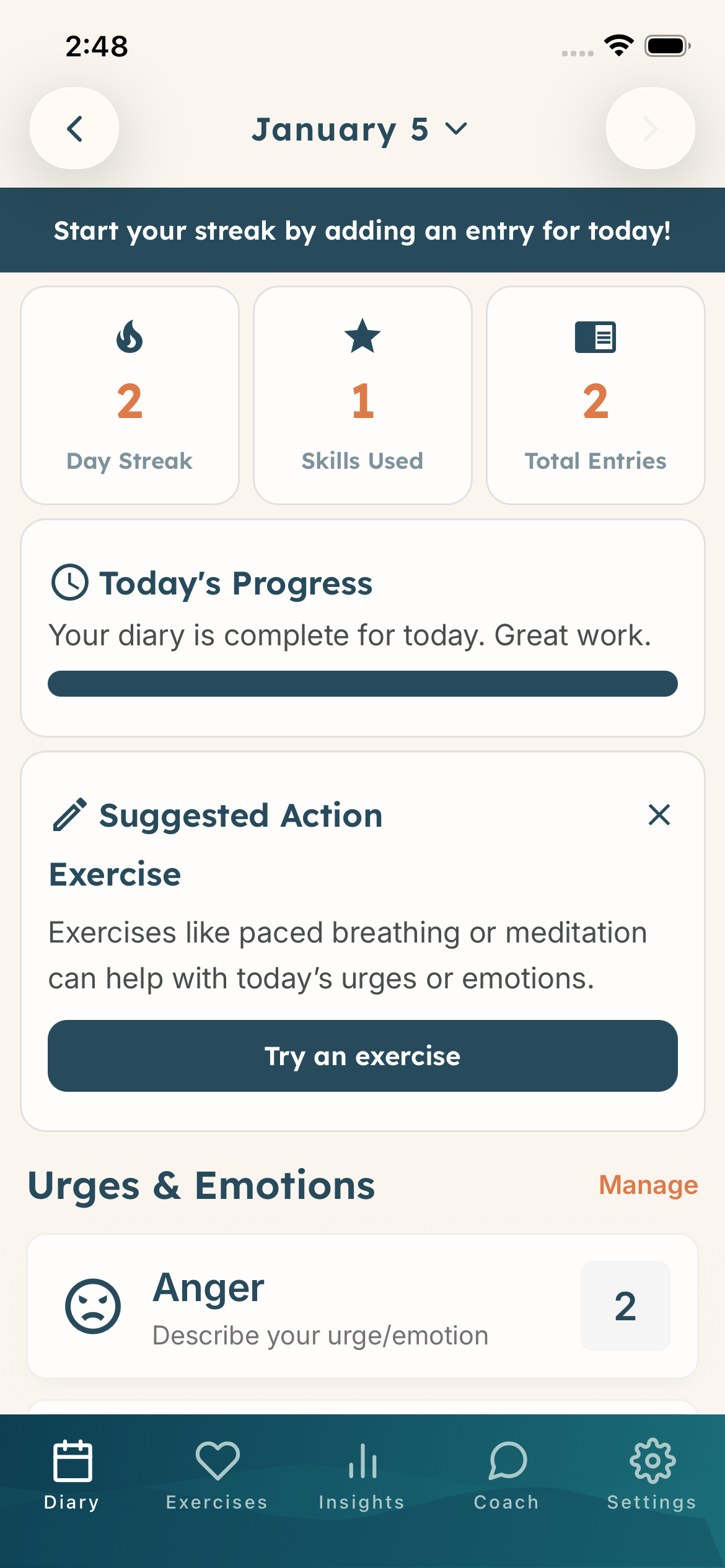
Download DBT Pal — free emotion regulation tracking
Download DBT PalFAQ
What are the main DBT emotion regulation skills?
Check the Facts, Opposite Action, PLEASE, and ABC (Accumulate positives, Build mastery, Cope ahead). Each targets a different aspect of emotional management.
How is emotion regulation different from distress tolerance?
Distress tolerance helps you survive intense emotions. Emotion regulation helps you change them. Distress tolerance is for crises; emotion regulation is for ongoing management.
How long does it take to learn these skills?
Most DBT programs teach them over 8–12 weeks. Proficiency comes with ongoing practice. Many people see improvement within the first few weeks, especially with Check the Facts and PLEASE.